Teaching Kitchen Collaborative
The Research & Evaluation Toolkit
The Research & Evaluation Toolkit
Couldn't load pickup availability
The TKC is proud to present The Research & Evaluation Toolkit: A Practical Guide for Teaching Kitchen Programs, a resource to help you measure what matters, strengthen your program, and demonstrate its value.
Active TKC Professional, Organization, or Corporate Members receive complimentary access to this toolkit as part of their membership benefits. You can access your discount link through the member portal or by reaching out to us at info@teachingkitchens.org.
The toolkit download is for individual use only. By purchasing and downloading the toolkit, you’re supporting the TKC’s mission to improve lives through transformative culinary and lifestyle education. If others in your organization want access, please contact us to discuss group discount options.
About the Toolkit
What is your teaching kitchen achieving? How can you use that information to improve delivery, communicate results, and build support for its future? This toolkit helps you answer those questions with a practical approach to research and evaluation that fits your program’s goals, resources, and experience. Whether you’re gathering feedback from your first class series or preparing a study for publication, it helps you identify useful questions, select appropriate methods, and turn findings into informed decisions.
Developed by Ghislaine Challamel, MSc, Catherine McManus, PhD, RDN, LD, and Jennifer Massa, ScD, with contributions from the TKC’s Research Committee and Research Fellows, this resource brings together six focused evaluation toolboxes, worked examples, sample questions, and links to published measurement instruments. Explore participation and retention, participant experience, stakeholder engagement, sustainability, learning and behavior, and health outcomes. Each section helps you determine what to track and understand what your findings mean. It also helps you recognize the limits of your evidence so you can communicate results accurately.
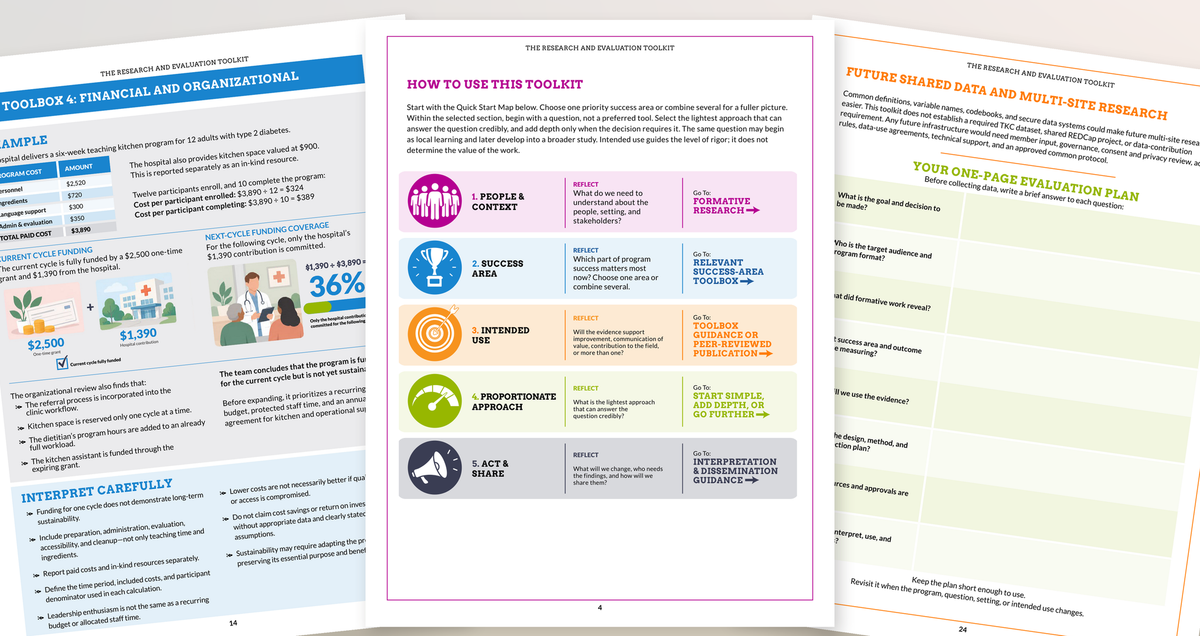
Designed for flexible use, the toolkit lets you begin with your most pressing question and add depth as your needs evolve. A one-page evaluation plan helps organize your next steps, while guidance on study design and peer-reviewed publication supports teams ready to contribute knowledge to the broader field. Together, these resources help you make a more credible case for your program’s value to participants, partners, organizational leaders, and funders.
What’s Inside
- A practical planning framework, including a Quick Start Map and one-page evaluation plan, to define meaningful questions, identify resource needs, and build an evaluation approach aligned with your program’s goals
- Focused evaluation toolboxes with sample questions, tracking tables, and worked examples to assess participation and retention, participant experience, stakeholder engagement, sustainability, behavior change, and health outcomes
- Guidance for selecting appropriate measurement instruments, with links to published tools and resources to assess their suitability for your participants, setting, timeline, and evaluation goals
- A structured pathway from interpreting findings to communicating program value and preparing for peer-reviewed publication, with guidance on study design, research partnerships, oversight, analysis, and reporting
Intended Audience
This toolkit is designed for program managers, educators, chefs, registered dietitian nutritionists, clinicians, community partners, administrators, students, evaluators, and researchers working with teaching kitchen programs. It supports a range of settings and experience levels, from teams beginning with attendance records and participant feedback to those planning more advanced research.
You do not need a research background or a large study to begin. The toolkit helps you choose a manageable approach that answers a meaningful question. The information you collect can then support better programs, stronger partnerships, and more informed funding decisions.
Share